
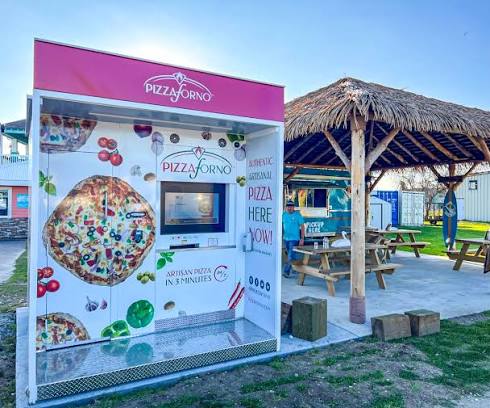
The machine is not the business plan. A durable pizza vending operation begins with a real meal gap, a serviceable location, disciplined food handling, and conservative unit economics.
By VendoPizza Editorial Team
Unattended retail is no longer limited to snacks and bottled drinks. Smart payment systems, connected equipment, and remote monitoring have made it possible to sell complete hot meals in places where a staffed kitchen may be impractical. Pizza is especially well suited to this format because customers understand the product immediately, recipes can be standardised, and demand can extend from lunch and dinner into late-night and shift-work hours.
The wider market is already substantial. The European Vending & Coffee Service Association reported approximately five million machines, five billion annual vends, and €26.4 billion in product revenue across Europe based on market data through the end of 2024. It also reported that cashless systems were fitted to 85% of the pay-vend machine base. EVA market report summary.
Those figures show that consumers and location owners are already familiar with unattended retail. They do not, however, make every pizza vending project profitable. Hot-food vending adds refrigeration, cooking, food-safety, replenishment, customer-support, and maintenance responsibilities. A prospective operator should therefore make nine commercial decisions before placing an order.
What This Guide Covers
1. Define the unmet meal occasion
2. Select the operating format before the machine
3. Build the economics from contribution margin
4. Audit the exact installation point
5. Design the replenishment and cold-chain route
6. Engineer a menu for automation
7. Plan payments, monitoring, and customer recovery
8. Negotiate a site agreement that protects the pilot
9. Define success before scaling
1. Define the Unmet Meal Occasion
The first question is not “Where is there footfall?” It is “Where are people unable to get a convenient hot meal at the moment they need one?” A busy location surrounded by open restaurants may convert poorly, while a smaller site with night workers and limited alternatives may produce steadier demand.
Observe the proposed location during the hours when the machine would actually trade. A daytime visit cannot reveal what happens after a cafeteria closes, during a factory shift change, or when a transport connection is delayed. Record who is present, how long they remain, what alternatives are available, and whether customers have enough time to order and wait.
Hospitals, universities, hotels, industrial sites, residential complexes, petrol stations, and transport locations can all work, but the label alone proves nothing. The operator must identify the exact customer and the exact meal gap.
2. Select the Operating Format Before the Machine
Pizza vending machines can use different product workflows. Some prepare dough or core ingredients inside the unit. Others store refrigerated, pre-prepared pizzas and bake them after purchase. A third group uses chilled or frozen stock-and-bake products. These formats create different demands for production, cold storage, cleaning, replenishment, technical skill, and menu flexibility.
The correct choice depends on the operator, not on which machine has the most impressive feature list. A pizzeria with an established kitchen may value a refrigerated fresh-bake workflow that extends its brand. A first-time operator may prefer a simpler stock-and-bake system with standardised loading. A premium location may justify a more complex fresh-production experience if the team can support it consistently.
Before requesting quotations, buyers can use VendoPizza’s pizza vending machine comparison guide to compare preparation format, typical capacity, serving cycle, placement, and remote-management features. Final decisions should always be based on the exact model code, technical sheet, destination, electrical configuration, and written quotation.
The commercial principle is simple: choose the workflow your organisation can execute every day, including weekends, holidays, staff absences, and unexpected service events.
3. Build the Economics From Contribution Margin
A revenue forecast can make almost any location look attractive. A contribution model is harder to fool. Start with the money retained after serving each customer, then subtract the costs required to keep the location operating.
| Monthly sales | Average transactions per day × average selling price × trading days |
| Gross contribution | Monthly sales − food cost − packaging − payment-processing fees |
| Site contribution | Gross contribution − rent/revenue share − utilities − replenishment labour − travel − cleaning − waste − maintenance reserve |
| Break-even transactions | Monthly fixed site costs ÷ contribution earned per pizza |
Prepare at least three cases: a base case, a downside case, and an upside case. The downside case should test lower sales, higher waste, an extra service visit, and a period of downtime. A project is stronger when it remains manageable under imperfect conditions, not only when every assumption goes right.
Avoid using launch-week curiosity as the long-term sales rate. Likewise, do not count potential advertising income, sponsorship, or future network discounts unless there is a signed commercial basis for doing so.
4. Audit the Exact Installation Point
A promising building can contain a poor installation point. The machine needs visibility, safe approach space, appropriate power, service clearance, connectivity, environmental protection, and a workable delivery route. Each requirement must be checked against the exact machine configuration rather than a general product category.
Walk the route from the delivery vehicle to the final position. Measure doors, lifts, corners, ceiling heights, floor transitions, and turning space. Confirm whether panels or components require front, side, or rear access. Check whether customers can order and wait without blocking an entrance, emergency route, reception desk, or busy corridor.
Outdoor and semi-outdoor projects require additional review of direct sun, rain, drainage, wind exposure, ambient temperature, vandalism risk, lighting, and nighttime safety. “Outdoor capable” should be verified for the selected configuration and destination, not assumed from a marketing photograph.
5. Design the Replenishment and Cold-Chain Route
The service route is part of the business model. A machine may generate acceptable sales and still underperform if every restocking visit requires long travel, complicated security access, or excessive handling time. Route density often matters more as a network grows because several nearby sites can share production, stock, labour, and technical support.
Define where pizzas are prepared or received, how they are transported, how required temperatures are maintained, where packaging and cleaning materials are stored, and how expired or damaged products are removed. Set par levels by daypart and use first-expired-first-out rotation rather than relying on memory.
EU food-hygiene rules place primary responsibility for food safety on the food business operator, emphasise the need to maintain the cold chain for food that cannot be stored safely at ambient temperature, and require hygiene procedures based on HACCP principles where applicable. Regulation (EC) No 852/2004 provides the general EU framework; national and local requirements must also be checked before trading.
6. Engineer a Menu for Automation
A successful vending menu is not simply a restaurant menu placed inside a machine. Every product must be compatible with storage, packaging, the heating or baking profile, collection, and the time customers are willing to wait.
Start with a focused range. A useful opening structure is one familiar bestseller, one meat-free option, one premium choice, and—where demand supports it—one local or seasonal recipe. Too many products divide inventory, increase forecasting difficulty, and can create waste before the operator has reliable sales data.
Standardise the portion, weight, box dimensions, recipe, product code, storage instruction, allergen record, and machine programme for every item. Test output at the beginning and end of a stock cycle, not only with freshly loaded product.
Food information must be clear and accessible. European Commission guidance explains that food-information rules apply across the food chain and that allergen information is mandatory for non-prepacked foods, while Member States may impose additional national requirements. European Commission food-information guidance should be reviewed together with local advice.
7. Plan Payments, Monitoring, and Customer Recovery
Automation is valuable only when information leads to action. The operator should know who receives alerts, how quickly they are reviewed, and what response follows a temperature warning, low-stock message, payment fault, door event, or equipment error.
Test connectivity at the exact machine location and during busy periods. Confirm that the payment hardware supports the local market, currency, and preferred methods. Decide how refunds are issued and give customers a visible support route, such as a telephone number or QR code, so a failed transaction does not become a public complaint.
Create simple response standards. For example, a payment fault may require remote review within minutes, while a food-temperature alert may require immediate sales suspension and product assessment. The correct timing depends on the incident and operating procedure, but ownership must never be ambiguous.
8. Negotiate a Site Agreement That Protects the Pilot
The property agreement should support learning during the pilot, not lock the operator into an unproven location. A long lease with high fixed rent can turn a testing exercise into an expensive obligation. Where possible, use a defined trial period, reasonable exit terms, or a commercial structure that shares risk.
The written agreement should clarify:
• Rent, revenue share, and exactly how revenue is calculated
• Who pays for electricity, connectivity, installation work, and permits
• Access hours for replenishment, cleaning, and technicians
• Security, surveillance, vandalism, and insurance responsibilities
• Branding, signage, menu displays, and promotional rights
• Customer complaints and incident escalation
• What happens during downtime or a utility interruption
• The right to relocate or remove the machine if the pilot fails
A clear agreement protects both parties. The site owner understands the service being provided, and the operator can maintain the machine without repeated permission delays.
9. Define Success Before Scaling
A pilot should test an operating model, not merely confirm that people will buy pizza once. Define the review period, the metrics, and the decision thresholds before launch. The test should be long enough to include normal weekdays, weekends, and relevant demand cycles without relying on opening-week novelty.
| Area | Primary measure | Management question |
| Demand | Sales by hour and day | Is demand recurring or driven by a temporary event? |
| Margin | Site contribution | Does the location make money after route and site costs? |
| Product | Sell-through, stock-outs, waste | Is the menu balanced and forecastable? |
| Reliability | Uptime and payment success | Can customers buy when demand occurs? |
| Operations | Minutes per service visit | Can the site be supported efficiently? |
| Experience | Complaints, refunds, repeat signals | Do customers trust and reuse the service? |
At the end of the pilot, choose one of five actions: continue, optimise, renegotiate, relocate, or stop. Scaling should follow only when the operating process is repeatable and the economics remain acceptable after realistic labour, travel, waste, and downtime costs.
A Practical 30-Day Pre-Investment Plan
The following sequence helps a new operator avoid buying equipment before the project is defined.
1. Days 1–7: Observe two or three candidate locations at relevant dayparts and write a one-sentence demand case for each.
2. Days 8–12: Choose the preferred product workflow and shortlist machines using model-specific capacity, power, footprint, payment, and placement requirements.
3. Days 13–18: Build base, downside, and upside unit-economics cases. Include route labour, waste, maintenance, and downtime reserves.
4. Days 19–23: Complete the physical-site audit and obtain written confirmation of power, access, environmental, security, and connectivity conditions.
5. Days 24–27: Draft the food-safety, allergen, cleaning, replenishment, alert, refund, and incident procedures.
6. Days 28–30: Negotiate pilot terms, define the scorecard, verify the final technical documentation, and request a destination-specific quotation.
Five Mistakes That Weaken New Pizza Vending Projects
Buying the machine before securing a validated location: This reverses the decision process and encourages the operator to force a machine into a site that may not support it.
Using footfall as the only demand measure: Footfall does not reveal meal timing, available alternatives, customer dwell time, or willingness to wait.
Forecasting revenue without route costs: Travel, access delays, cleaning, and replenishment time can absorb margin even when sales look healthy.
Launching with too many menu items: A wide range increases forecasting complexity and waste before enough sales data exists.
Treating the machine as passive income: Unattended selling still requires active food operations, maintenance, monitoring, and customer support.
The Strongest Investment Is the Operating System
A pizza vending machine can extend hot-food access into locations and hours that are difficult to serve with a staffed outlet. The opportunity becomes credible when the operator validates a real meal gap, chooses a manageable product workflow, understands site-level contribution, protects food safety, and treats service response as part of the customer experience.
The machine is the visible asset. The operating system—location selection, replenishment, menu control, maintenance, monitoring, and disciplined pilot review—is what creates a business that can be repeated across multiple sites.
Start with one location that can be measured honestly. Make the process reliable. Scale only after the numbers and the day-to-day operation agree.
Frequently Asked Questions
Is a pizza vending machine business passive income?
No. The point of sale is automated, but stock preparation, replenishment, cleaning, temperature control, maintenance, monitoring, refunds, and financial management still require active ownership.
What is the best location for a pizza vending machine?
The best location has a clear unmet meal occasion, suitable infrastructure, safe customer access, practical replenishment, reliable connectivity, and site economics that work under conservative assumptions.
How many pizzas must a machine sell each day?
There is no universal number. The required volume depends on selling price, contribution per pizza, rent or revenue share, route cost, labour, waste, maintenance, and finance costs. Calculate break-even transactions for the exact site.
Should a new operator choose fresh-dough or stock-and-bake equipment?
Choose the format your team can operate consistently. Fresh-production systems may offer a stronger theatre and product story, while refrigerated or frozen stock-and-bake formats may simplify standardisation. Compare the complete workflow, not only serving time.
What should be confirmed before ordering a machine?
Confirm the exact model, preparation format, capacity, footprint, weight, electrical supply, installation environment, payment hardware, connectivity, documentation, warranty, service responsibilities, delivery basis, destination, and total quoted configuration.
Author Biography
VendoPizza Editorial Team publishes practical guidance on automated food retail, pizza vending formats, site planning, food safety, and European deployment. VendoPizza helps commercial buyers compare machine configurations and obtain destination-specific quotations for their intended location.
